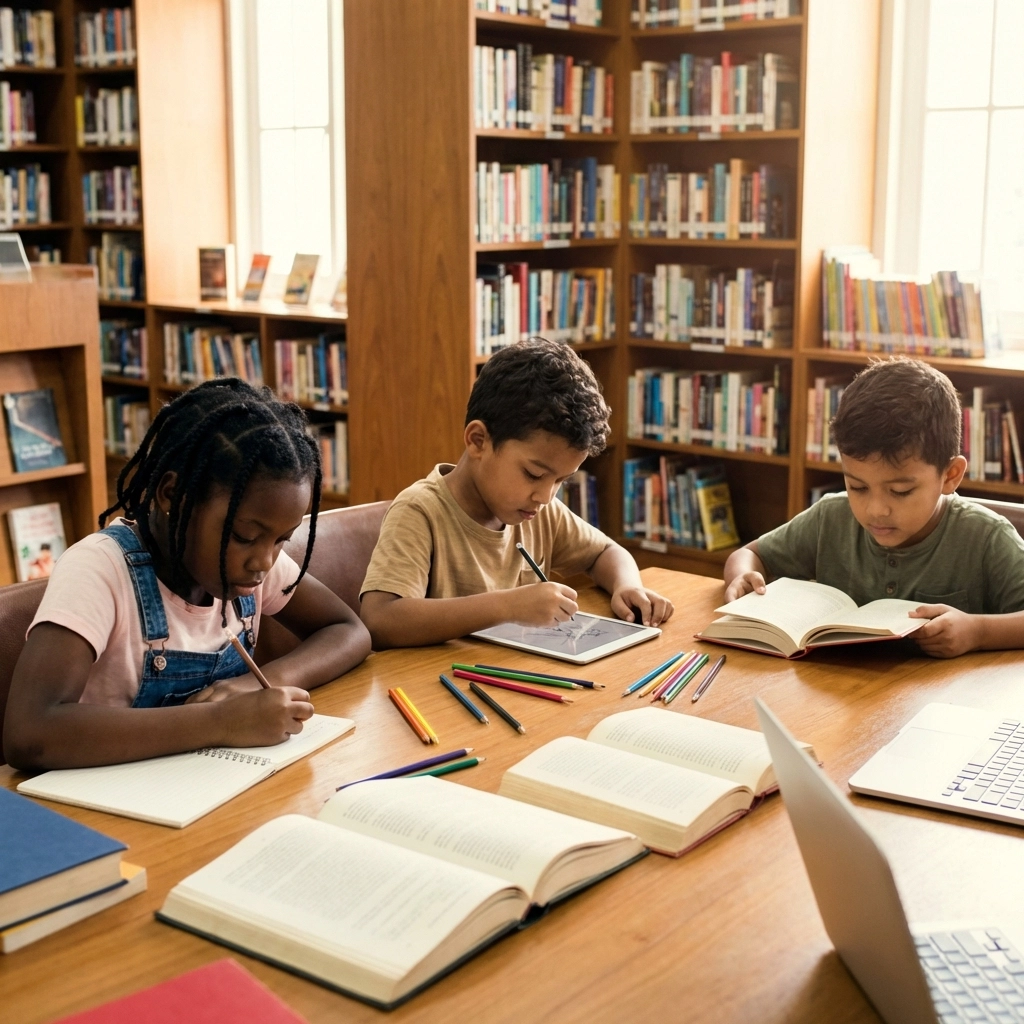
Here’s a conversation I hear far too often: “We’d love to sign little Emma up for creative writing classes, but with maths tutoring, piano lessons, and football practice, there’s just no time left for the fun stuff.”
Creative expression gets relegated to the “nice-to-have” category, something we squeeze in after the “important” subjects are covered. But here’s the thing: this thinking is completely backwards.
Creative expression isn’t the cherry on top of a child’s education. It’s not a luxury reserved for families with extra time and money. It’s actually one of the most fundamental building blocks of healthy child development, right up there with learning to read and basic numeracy.
I’ve spent years working with young writers at Accomplish Press, and I can tell you this with absolute certainty: the children who engage regularly in creative activities: whether it’s storytelling, art, music, or imaginative play: consistently show stronger problem-solving skills, better emotional regulation, and more resilience when facing challenges.
The brain-building power of creativity
Let’s start with what happens inside a child’s head when they’re being creative. When your seven-year-old is making up stories about flying elephants or your ten-year-old is writing poetry about their pet hamster, their brain is doing some serious heavy lifting.
Creative activities build what researchers call “divergent thinking”: the ability to approach problems from multiple angles and generate original solutions. Think of it as mental flexibility training. When children create stories, they’re constantly making decisions: What happens next? How does this character solve their problem? What if we tried this instead?
These are the same cognitive muscles they’ll use in maths when tackling problems, in science when forming hypotheses, and later in life when navigating complex workplace challenges. The child who spends time inventing elaborate fantasy worlds is actually developing the same neural pathways they’ll need for spatial reasoning and abstract thinking.
Emotional intelligence through creative expression
But perhaps the most crucial benefit of creative expression is emotional. Children experience big feelings: frustration, excitement, disappointment, joy: and they often lack the vocabulary or framework to process these emotions effectively.
Creative activities give them a safe space to explore and express what they’re feeling. Through drawing, storytelling, or dramatic play, children can work through complex emotions without fear of judgment. They can make their characters face the same fears they’re experiencing, or create scenarios where everything works out perfectly.
I’ve watched young writers in our programmes tackle difficult topics through their stories: moving house, parents divorcing, friendship troubles, or even global events that confuse and worry them. Writing gives them a sense of control and helps them make sense of their world.
This emotional processing isn’t just therapeutic in the moment; it builds lasting emotional intelligence. Children who regularly engage in creative expression develop better self-awareness, empathy for others, and resilience when facing difficulties.
The social superpowers of creative play
Here’s something that might surprise you: creative activities are actually incredible social skill builders. When children collaborate on creative projects: whether it’s writing a story together, putting on a play, or working on an art piece: they’re practising essential life skills.
They learn to:
- Share ideas and build on others’ contributions
- Negotiate different viewpoints
- Compromise when their vision doesn’t match their friend’s
- Communicate their thoughts clearly
- Support teammates when things go wrong
Group storytelling, in particular, is like a masterclass in cooperation. Children have to listen actively, take turns, and find ways to weave their individual ideas into a cohesive narrative. These are the same skills they’ll need for successful teamwork throughout their academic and professional lives.
The academic connection you can’t ignore
Now, for those parents who are still thinking, “This is all lovely, but what about their test scores?”: I’ve got some good news for you.
Research consistently shows that children who regularly engage in creative activities perform better academically across all subjects. Creative expression strengthens focus and concentration, improves memory retention, and enhances critical thinking skills.
Children who write creatively develop stronger vocabulary, better grammar understanding, and more sophisticated sentence structures. They become more confident communicators, both in writing and speaking. The storytelling skills they develop help them understand narrative structure, which directly transfers to reading comprehension.
But the benefits extend far beyond literacy. The problem-solving skills developed through creative play transfer to mathematical thinking. The patience and persistence required to complete creative projects build the kind of sustained attention that’s crucial for academic success.
Practical ways to nurture creativity at home
So how do you make creative expression a priority in your child’s life? The good news is that it doesn’t require expensive classes or fancy materials. Here are some simple strategies:
Create regular creative time. Just 20-30 minutes of unstructured creative play each day can make a significant difference. This means no screens, no specific outcomes: just time for your child to explore their imagination.
Embrace mess and imperfection. The goal isn’t to create masterpieces; it’s to engage in the creative process. Let them experiment, make mistakes, and try again.
Ask open-ended questions. Instead of “What did you draw?” try “Tell me about your picture.” Instead of correcting their stories, ask “What happens next?”
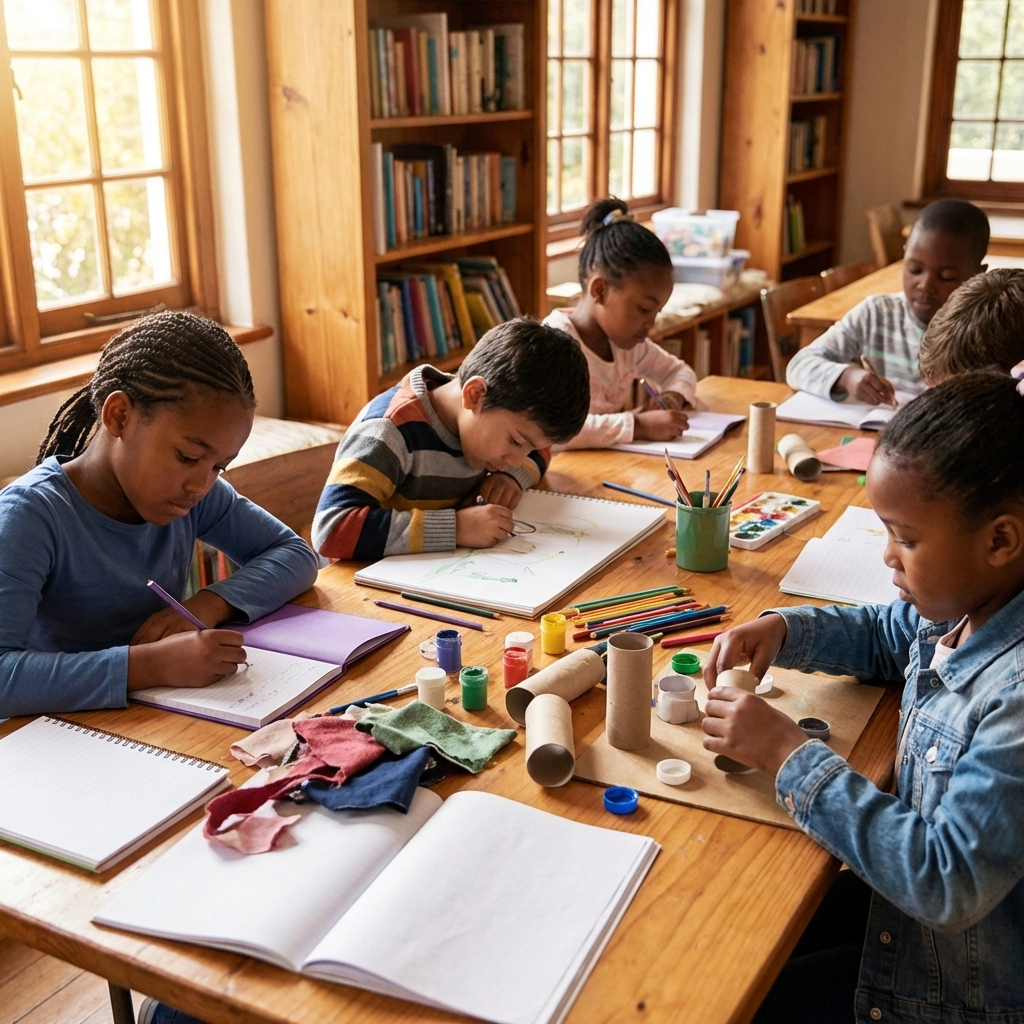
Provide varied materials. Keep a creativity box with paper, crayons, recycled materials, dress-up clothes, and simple props. Rotate materials regularly to maintain interest.
Share the process. Write stories together, take turns adding to drawings, or create family plays. When children see adults being creative, it normalises and encourages their own expression.
Supporting creativity in educational settings
For educators, integrating creative expression into daily learning doesn’t mean sacrificing academic rigor: it enhances it. Some effective approaches include:
- Using storytelling to teach historical events
- Incorporating creative writing into science journals
- Allowing artistic responses to literature
- Creating classroom plays to explore social issues
- Using creative problem-solving techniques in maths
The key is viewing creativity as a learning tool, not a separate subject.
Why this matters more than ever
In our increasingly digital world, the ability to think creatively, solve problems innovatively, and express oneself authentically isn’t just valuable: it’s essential. The jobs our children will have might not even exist yet, but they’ll definitely require adaptability, original thinking, and strong communication skills.
Creative expression builds these future-ready skills naturally and joyfully. When we treat it as optional, we’re actually disadvantaging our children in ways we might not realise until much later.
At Accomplish Press, I’ve seen firsthand how creative expression transforms not just children’s writing abilities, but their confidence, their problem-solving skills, and their overall approach to challenges. The young writers who come through our programmes don’t just become better storytellers: they become more resilient, more empathetic, and more capable human beings.
Ready to nurture the creative potential in the young people in your life? Whether you’re a parent looking to support your child’s creative development or an educator seeking to integrate more creative expression into your classroom, I’m here to help. Whether you’re looking for one-to-one coaching to help a budding writer develop their skills, or you’d like to enrol them in our Creative Writing Club, I’m here to help. As someone who’s dedicated my career to nurturing creative voices, I understand the unique needs of young writers and the incredible potential they hold.
I’ve seen countless children gain confidence, improve their problem-solving skills, and discover a love of learning through our structured yet creative approach. Registration for January term is now open! Click here to register your child now.